II Donald Flanders 30
You have asked, what sort of question might have aroused my anger about Russia. I may have exhibited anger at what I felt was too inflexible an attitude toward Russia. The word appeasement has a very unfortunate connotation. I would not like to apply it to these remarks. But rather shall we say, it seems to me the facts are that Russia is on the face of this globe, and we are on the face of this globe. If any reasonable way can be found by which we can co-exist, that is preferable to assuming on our part a doctrinaire attitude that the things Russia stands for within her own borders are such that we must destroy Russia. Now, this does not mean that I am unalterably opposed to carrying war against Russia. The circumstances may arise where it seems to be unavoidable. It comes very close to seeming so to me now. I see at the present time very little hope of escape from such a war. There is no question in my mind that I shall be on the side of the United States in such a war. Yet, any reasonable effort, any honorable effort that can be made to prevent such a war seems worthwhile.
Donald Flanders
Q. In the event of a war against Russia, you are testifying that you would perform any military duties requested of you, is that right?
A. Absolutely yes. My attitude toward Russia has changed in the course of they years, as a result of what seems to me clear evidence of bad faith on Russia's part, their total unwilling ness to make any genuine effort to solve problems, international problems; their obstructionist tactics in the UN; their hypocrisy in the use of the term democracy; their hypocrisy in their attitude toward science; there are now hundreds of things that are now clear that I didn't know, that were not revealed in 1946 and 1947.
I am trying to recall the state of my mind and what sort of question might have aroused my anger. I have no specific recollection, and I wasn't trying to think of a particular incident, because I don't have any in mind. I am quite sure I have lost my temper in that period on the subject of Russia, and shall we say, roughly speaking, in defense of Russia as against some other person in argument. But I find it difficult to reconstruct this sort of thing.
Q. What is your attitude on the so-called Lysenko controversy?
A. Of all the sciences, I know the least about biology. I tend to accept the prevailing opinion of supposedly reputable scientists about biology. I haven't found anything in it that seems to be unreasonable so far as I know anything about it. What I have read makes me think that htis Lysenko business is pure hogwash; that the Russians are just, well, whatever motives, whatever the mechanism, that it is a fundamentally dishonest pseudo-science.
Q. Do you recall ever having advocated a "one-world" type government?
A. I do not, and it seems to me rather doubtful. That is, I would say that on the surface, one world government would appeal to me emotionally as the sort of thing one would like to see. But, in practice, ever since the time to realize, or in my estimation, that the problem is so complex that it doesn't seem to me that it is ever worth doing much about at the present time. That solution is too remote. That is a dated millennium.
****
I had a conversion, not from a love of communism, which I never had, but from a feeling that cooperation with Russia was possible to my present feeling that cooperation is almost impossible.
Now, this did not take place overnight, and I cannot possibly give you a precise date. My recollection is not good enough to tell me now just what
II Donald Flanders 31
had been committed and what had not been. Czechoslovakia, so far as I was concerned, was certainly an outrage. I think I had very little sympathy for Russia at that time. Romania, I think, I was not as clear about. It still left some margin for doubt. That is, we are dealing with a practical world. The action was undoubtedly far from ideal, but the Romanians--I know little about Romania--they are, I believe Slavs, by and large. They are, I believe, directly on the border of Russia, and there might be some excuse in terms of the Romanians themselves wishing, on purely ethnical grounds, to wish to be allied with the Russians. The fact that Russia took an unfair advantage, well, that was not too good, but it was not a final and conclusive situation. That is, once an attitude--I don't like to make statements like that. One's attitude doesn't generally change overnight. It is an accretion sort of thing. I am sure the Romanian business was not the last thing.
Q. What is the occupation of your daughter Ellen's husband?
A. He is a student at the University of Chicago, and he is at the same time doing such work as he can get to augment the family income. At the present time, I think his sole job is that of developing film for the cosmic ray experiments of Marcell Schein in the Physics department of the University.
Q. Do you know his political posture?
A. Roughly speaking, yes. He comes from a North-Side family, and they were originally quite well to do. His father has died. I met his mother. He seems to me to be a very curious mixture of basically rather conservative views. I am sure that his family and his friends that he grew up with were all staunch Republicans, and that he started out a staunch Republican. But somewhere along the line he has been subjected to some other ideas, and he somewhat more liberal ideas than I would expect. He is, for example, I am sure, a very strong exponent of the free enterprise system, and probably a more an extreme one than I would be. That is, he probably feels less the need of governmental checks and regulation of so-called free enterprise than I do. I would never describe him as a radical in any of his views. It seems to me he is in a sort of fluid state. He has a basic quite conservative, if not even reactionary, original pattern. But there is no evidence that he is getting even to the left of center by this time, I would say.
Q. About your daughter Ellen, the impression one may get is that she has been pretty far to the left of center, is that right?
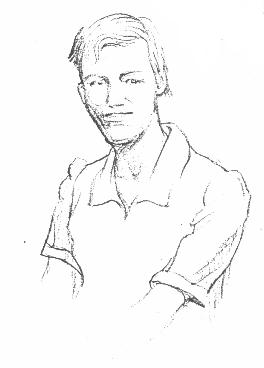
A. As far to the left of center as to be liberal in her thinking, and to wish to enquire into her position further to the left, including Marxism. I do not think that one could honestly say that she has ever adhered to Marxist theories. She has enquired into them. I do not think she has ever given he adherence to them. She has not been a communist.
Q. Has she been a communist sympathizer, or a fellow traveler?
A. I would not classify her as either. That is, she has never followed the party line, the sort of things that are indicated by those sudden shifts of position due to the fact that Moscow suddenly decided that--I can't think of a particular example, but we all know there have been these sudden shifts. We have observed people changing their ideas overnight to agree with that.
Ellen Flanders
II. Donald Flanders 32
That sort of thing, never. I would classify her as within reasonable limits a free and independent and inquiring individual, a young woman who is feeling her way. She is now 25.
Q. And this period of time during which she was a member of the Socialist Youth League--she lived with the Meyers?
A. No. In 1948-49 my two daughters lived in the lower downstairs apartment of our house. That broke up at the end of the year, and we then rented to the Meyers. I wouldn't be able to tell without considerable research where they moved to, because they lived at this place and that, getting rooms around the University.
Q. You see your daughter now, don't you? Have you noticed any moderation, possibly, in her views as her married life goes on?
A. If you will allow me to refer to a question asked recently, I said then, I did not regard her as ever having held Marxist views. She inquired into them. I cannot say with definiteness that my daughter's views have been particularly modified. I can certainly say that because she is studying, carrying three small part-time jobs, and taking care of her child and family, she doesn't have much time left for political and social activities. Because of the baby, such ideas are less common in her conversation when we see her. Actually, I think almost everything pretty much centers on the baby unless it happens that we are playing music.
From Ellen's words, and from my impression of her attitudes, and my knowledge of her, I am satisfied that she is not going to go in for anything in the extreme.
Q. In your responsive letter, you describe the thinking of Miss Kraft in the following words, "We became aware that her political thinking was unorthodox." That, to me, means that you became aware that she was a communist, is that so?"
A. No, I would not say that that was a reasonable conclusion to draw from that. I would not regard even socialism as orthodox political thought.
*****
Q. Were you active in the Progressive Citizens of America?
A. We joined a local chapter in Chappaqua in the winter of 1946-47. We attended fairly regularly. They met perhaps once a month. I was never an officer or committee member.
I did give one talk on the atomic bomb, using photographs and a film that had been declassified. That is the full extent of my activity, except for the one general meeting, which caused me to become disaffected. That meeting had two or three days of sessions. The decisive session for me dealt with the contempt of court action against certain officers of something like the Spanish Refugee Committee. There I heard Professor Bradley of NYU, who had been judged guilty of contempt, speak. I felt he was a perfectly honorable and sincere man, very moderate in his statements, and if everyone had behaved like him, I would have been well satisfied. But, the speakers from the floor were so unrestrained, so intolerant of the people they were opposing, that I just couldn't stomach them.
Q. Did you then suggest communist domination?
A. I was not and I do not know that I really ever am particularly interested
II. Donald Flanders 33
in the label of the type of domination. I recognized this sort of thing as being distasteful to me, and it seemed to me destructive, not constructive. I wasn't going around looking to see if people were communists. I still to this day do not look at whether people are communists. I judge them for what they are.
Q. Would you today be a member of an organization you suspected of being communistically infiltrated?
A. I might easily do so if I felt that it would be possible to overcome that domination; if it were important to do so, that is, if I felt that the fundamental aims of the organization were such that, it was one that one should fight the tactics of the communist type.
Q. Did your wife end her participation when you did?
A. I am fairly certain my wife did not participate after we left Chappaqua.
Q. Are you or have you ever been a member of the Communist party?
A. I am 99.999 sure that I have never joined the communist party.
Q. You can't make that 100 per cent, can you?
A. On general principles, I refuse to make it 100%.
****
I am in complete sympathy the aims of security measures. I am not in accord with all of the details of it, even the criteria, procedures, etc. I am in sympathy for the need for security for this general sort of approach. I would feel that I have no lower estimate of the need for security that the Board members do.
Now, these things are administered by human beings. They are subject to the judgements and the decisions of human beings. I see no reason to assert, without very careful thought, that I agree with everything being done by security.
Q. Are you willing to subordinate your judgement on these matters of details to the judgement of the security officials?
A. Not wholly.
Q. Am I to understand that you wouldn't be bound by them?
A. That is quite a different matter. I feel myself bound by them. I would carry out the regulations as I understood them. I would either carry them out or I would resign. I would carry out regulations with which I did not agree. I would not, however, subordinate my judgement to the judgement of the security officials, only my acts. I would try to abide by them.
Q. You would act in accord with them, even though you retain the right to disagree with the principles of them?
A. Yes. May I say a word about the bearing of this on my own case. I believe it is true that the present criteria, the present regulations, were not in force when I joined the Argonne Laboratory in 1948. I do not remember the details of what the regulations then were. I do know that when I came to Argonne, I did so with the full intention of carrying out the spirit of the security regulations, and the letter, so far as I knew them.
I do not know whether the present criteria were ever called to my attention until this present hearing. I think they never were. It may be that criteria very close to them were, when I entered, and that I have simply forgotten. But, with respect to the present criteria, my behavior is not inconsistent with them, in particular, in the association with Alger Hiss.
It is my considered belief that these categories of derogatory information are to be considered as guides in the the determination; that they are not mandates; that the spirit of security criteria is "an overall commonsense judgement made after consideration of all of the relevant information as to whether or not there is risk that granting of clearance would endanger the defense of America."
As long as people who are engaged in work of this nature are expected to lead reasonably normal lives as citizens, as well as workers, it must be expected that they will have associations which may be deemed to be derogatory under these categories. In my estimation, association is far less significant than character and loyalty. It is only in terms of those that association has any significance.
Q. Would you report any knowledge of any communist of any other subversive that you might discover had access to classified information?
A. Surely.
Q. Did you approve of the Marshall Plan, of NATO, of the Korean Action(war)?
A. I approved of them all.
End
Testimony of Richard Courant