There is one event I have not previously mentioned. Somewhere along the way Ralph came down with scarlet fever, which he shared with his mother This was in 1924, early summer. They were both very ill. In those days I could not go to work if I lived at home and cared for the sick patients. So Eunice and I were shut off from the rest of the world. My only outside contacts were with the grocer who delivered food, the telephone, and the doctor. The patients stayed in bed on the second floor while Eunice and I ate, slept and lived on the first floor. Neither Eunice nor I contracted the illness. The patients, particularly the mother, were very ill and of course we were all in quarantine. We spent the whole summer with the danger sign on the front door.
Finally the doctor took us out of quarantine and we dashed up to the Perry camp on North Hero for about a week. It did us a world of good. My care of the sick was accepted as having been excellent and had one secondary achievement, very pleasing to Eunice's mother, who found that her daughter, under the patient training of the father, had become completely housebroken. Ralph, however, I have always felt suffered damage to his eyesight and hearing as a result of the illness. He had to wear glasses from an early age.
Any machine ever built, with use can be improved by redesign. Through the years changes were made and new products found that were improved by using our methods of grinding. From taps, to lead screws, to automotive parts, to very important parts used in jet engines. It was my job to try out our machines, taking whatever design and method changes were needed to bring success to the work at hand.
There were many interesting developments both in methods and design. It was my good fortune to be included in them all through the years.
Management finally decided that wider publicity must be given to new developments in form grinding. I was asked to give talks to engineering societies, one a month, anywhere in the northeastern United States north of the Mason-Dixon line, east of the Mississippi and north into Canada.
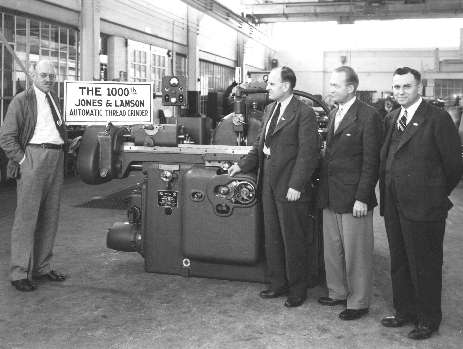
Thread grinder number one thousand.
Ralph Flanders on
left of machine, Ernest on right.
I did this for many years.
A list of some places in my files,
tells of the type and location
of a number of my talks.
I would like to describe one special talk given in Houston, Texas, in 1947. This was outside of my usual territory. It was the annual meeting of the American Society of Tool Engineers. I was invited to present a paper there. I could not refuse such an important opportunity, so I accepted, taking this opportunity to describe the methods of grinding wheel forming we had developed through the years. We had been very successful in undertaking very complicated forms required by industry. I gave them our story, a copy of which is appended here.
Grandmother Clare accompanied me to Houston. When it came time to leave, we decided to take a vacation before going home, by driving to Caifornia. We joined friends in Pasadena for a few days. Russell Porter joined us, taking us to Palomar, the home of the famous 200--inch telescope, newly constructed. Russell Porter was involved in the design and construction of this famous instrument (Photos 309, 310) with us also was Oscar Campbell, member of theSpringfield Telescope Makers and an old friend.
On our way home we visited Las Vegas, where we found gambling devices in every toilet we visited Continuing, we visited Zion Park and Bryce Canyon; then home, a long fatiguing trip in early spring.
When I returned I found that engineers at the General Electric Company who had attended the Houston meeting and had heard my talk had been trying to get hold of me. As soon as possible, I invited them to Springfield to present their problem.
Up to this time no machine had ever been designed to meet their require ments and needs. So-called buckets, made of heat-resistant rare metals, had to have duplicate faces, ground to a complicated wedge-shaped form called "Christmas-tree," that held these pieces in the perimeter of a large wheel. This wheel, rotating at very high speed, was subjected to intense heat, which steel cannot withstand. We had the answer for the successful produc tion of the pieces, but the machine for doing the work had to be designed and built. We promised to have a machine for them in six months, able to produce accurate work to meet their specifications. We took an order for five machines that had never been designed nor built that would produce 20 or more pieces an hour. This was done as promised and met all of their specifications in accuracy and production.
I have always derived a measure of satisfaction from this particular experience because, as the result of my technical lecture, we were selected to be the people who were foremost in providing a solution to a problem for which there was none until through our knowledge and experience we showed them how and gave them the means.
Following our success with G.E. we built many machines for other manufacturers of jet engines. The jet is now the standard motor for modern aircraft.
I have written too much about some areas of my work, but I would like to give one more example. From the start of our work, my brother and I were constantly looking for ways to build up accuracy in form grinding, starting with thread forms and winding up with so-called "Christmas tree" forms on jet engine buckets. These forms were held to extremely close tolerances, often expressed in tenths of one thousandth of an inch, Accuracy depended on the accuracy of mechanism guiding a correctly formed diamond across the face of the wheel. That is basic. The next area of absolute accuracy lies the shape of the diamond used in the operation. Diamonds vary in hardness, athough they are the hardest element known to man. The only way a diamond form can be changed is by using another diamond to do the cutting. Not one diaamond, but powdered diamond particles properly applied and guided. So forms of extreme accuracy were required, such as the ball groove of a bearing, that we were constantly searching for methods of maintaining accuracy that are simple and rapid.
One day while experimenting with the so-called crusher method of grinding wheel forming, it was suggested that a crusher roll covered with diamond particles might be a simpler and more accurate method to use. It never been done. So as usual we presented the idea to Koebel Diamond people in Detroit. After consultation and the design of special equipment to make this idea practical, we did what was necessary to make our initial moves into what I named "Perpetual Form Control." Koebel called their diamond cutters "Cemented Diamond Particles."
Our first tests on simple forms were very encouraging. One of the first applications was a means of forming a grinding wheel for grinding straight-sidod grooves in steel shafts. This was a common requirement and a troublesome one, due to the fact that there was no way to maintain complete form control on the grinding wheel. PFC gave that control. We were soon able to grind simultaneously several grooves, of different dimensions, in a shaft at one time. Where previously control rested with individual diamonds, our method divided the work between hundreds of diamond particles, no one particle having to do more than a small share of the work. As a matter of fact, many of the machines and PFC truing devices in the automotive field would operate for a full model year without diamond replacement. Older methods required replacement every day, due to diamond breakdown.
To bring our new process to full publicity, we invited members of technical journals to our plant for demonstration on the date of May 1, 1957.This demonstration went off successfully and received the publicity it deserved.
Most of us have outside interests, often not related to our work. This came to me in 1938, at the age of 43, through the influence of a close friend.I decided to interest myself in the Springfield Hospital. Responsibility for general operation of this facility rested in the hands of a Board of Corporators. These men and women accepted this without remuneration. From this group, trustees were chosen whose responsibility it was to find a salaried hospital administrator to give full time to the management of plant, personnel and services. Various committees were selected from the trustees, to whom the administrator reported. My friend George Perry, who was president of the Board, finally influenced me into allowing my name to be presented as a corporator. This was in 1938. In 1939 I was elected as a trustee, which brought me much closer to hospital management. And finally in 1944 I was elected president of the Board of Trustees. I resigned from the Board and as president fourteen years later, when hospitals were entering a new period of responsibility and I felt that a younger man would fit into the changes that seemed imminent.
By request I accepted membership on the Board again in 1960, finally resigning in 1969. Th 1980 when I finally resigned as a corporator, I was made an honorary lifetime trustee.
For me this all was a rewarding opportunity to give my time and effort to a very worthwhile service to the community.