did you correspond with the Hisses?
The defense was given the opportunity to challenge members of the board for cause, but did not do so.
Q. In 1950 after the conviction,
did you correspond with the Hisses?
A. It is, my friends will tell you, not my custom to correspond. I am a very poor correspondent. My wife had undoubtedly done so. The only letter I ever wrote to Alger Hiss in my life was in 19---I believe, I had better say, to the best of my recollection, was after the first trial in 1949. I do not wish you to draw from this the conclusion that this in any way interferes with my belief in my intimacy with Alger Hiss. It is simply a fact that I do not, write to any of my friends. My wife writes for me.
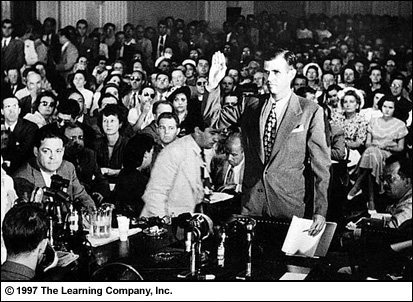
Alger Hiss swearing in.
Q. Did Priscilla invite you to visit her, or did your wife write to her?
A. Well, I think it could have been either way. it was probably more likely that my wife wrote. We plan our vacation schedule rather carefully in advance. We have just a month. We want to get to our farm New Lebanon, New York, and spend some time there. Both of us have relatives who we want to visit, but more particularly I, and friends whom we want to visit, so that we try to schedule our summer vacation in advance. I would, suppose that Mrs. Flanders undoubtedly wrote to Priscilla trying to arrange a date, a suitable date for us to visit them.
Q. Do you know whether or not Priscilla responded?
A. I sure she must have because we set a date, or an approximate date. I don't recall seeing such a letter I should say that it is a practice in our house that there is no mail, that is personal to my wife or to myself, so as far as our personal correspondence is concerned. One of us always reads the mail, aloud to the other. If there was a response, I saw it undoubtedly.
Q. Now what we would like to have you testify in as much detail as possible, at the start, is this relationship with Mr. and Mrs. Hiss. Did Priscilla Hiss ever state to you whether or not she was a Communist?
A. I have no recollection of any such statement.
Q. If such a statement were made to you it is likely you would recall it?"
A. That is very hard to say. Memory is capricious. It must be realized that the whole social attitude towards Communism has changed over these years. There was no such stigma, in my estimation, attached to being a Communist at the time,
In, my younger years, as there is at present. I would consider it conceivable that I might not have recollected such a statement. The only point about it would be that if she had made such a statement the chances are that it would not be isolated, that is to say, I would have been conscious of the fact that she was a communist. It is not that I would recollect a particular statement, but rather I would if she made the statement, I would undoubtedly have classified her, have categorized her in my mind as being a Communist, and would have, for whatever it is worth, associated her in mind with whatever ideas I have concerning Communism, which I never did. As for her saying she was not, it was, totally unnecessary as far, as I was concerned. I never had and do not now
II Donald Flanders 8
have the faintest belief she's ever has been or is a Communist.
Q. You have never in your mind at any time classified her or Alger as a Communist?
A. No. It is my impression that between 1931 and 1933, sometime I do know how long, and I don't know at what time that Priscilla was a dues paying member of the Socialist Party. That is my present impression of what was true then. It is my impression that it was Priscilla's interest that got my wife to join. That is my recollection. I did not join.
Q. You state that you and your wife's interest waned after a few meetings, and you never went in for a pure Marxism. What was your interest in it, may I ask?
A. I tried to refresh myself on this by looking it up the encyclopedia to find out, what socialism was, and I found it difficult to determine. I can tell you roughly what my general idea of the political philosophy of socialism was as I now think I thought around 1930. Namely, that it could be up, shall we say, in production for use rather than for profit. That the motivating force of the society as far as economic matters were concerned should be to produce goods rather than to make a profit. That, I would say, was what was the basis of my interest in socialism.
Communism was rather sharply distinguished in my mind by my belief--- I haven't read Marx--- but shall we say, to be a bit more specific, Communism at the moment is a word with such broad meanings that I would rather not use the term, and I would like to use the term Marxism as distinguished from "Socialism". What distinguished it for me at the time was that it was my impression that the Marxists were convinced that changes which would be needed to bring about this change in fundamental attitude, and motivation of the society, could be brought about only by only by violent revolution, and with that I did not agree. I felt that it, was possible to do these things peacefully and in an orderly manner within the framework of our own constitution.
I cannot say that I ever studied the. precepts of socialism. My main interest in life is music and mathematics and my family. I read Shaw's "Intelligent Woman's Guide to Socialism and Capitalism". That, I think, is about the only tract that I ever read on the subject, as far as I can recollect.
Q. I asked because the socialists claim, they arrogate themselves to the position of being the true exponents of Marxism.
A. I don't know. I am not well enough enlightened or informed to be able agree with you on that. As I say. I recently looked up the subject in the encyclopedia, and the origin of socialism is earlier than Marxism. Clearly Marxism derived from Socialism, if one is to believe the article in the encyclopedia Britannica, 14th Edition. I labor under the impression that Marx thought he was writing Socialism.
Q. Have you read the Marx and Engels Manifesto of 1948?
A. No, I have never' really been interested enough to go into Marxism at all. As I say, Communism has by now become a word that is almost meaningless. It covers such a multitude of sins that I would rather not use the word.
I will say for example that in some people's mind it is associated, shall we say, with membership in the Communist Party. That is a Communist. That is one definition of a Communist. Another definition is anyone who is actively sympathetic with their aims and so to speak, would, shall we say, like to be a member. A third use of the word Communist is essentially a Stalinist Marxist, meaning that the particular interpretations of Marxism that have been made by and are regarded as the ex cathedra pronouncements from Moscow, those constitute
II Donald 9
Communists. A fourth is those who believe in by and large, doctrines propgrated by Marx and Engels but are violently opposed to the interpretations that the Stalinists have put on this, the so called Trotzkyists. A fifth is--- I can't go on classifying these indefinitely-- but let us say, it has certainly been used in public utterances in this country to cover people whose opinions are not agreement with the speaker's. It is for this reason particularly that I don't wish to use the word "Communist".
Q. Do you not consider a member of the CP as also in the nature of a Stalinist Communist? You sort of duplicated.
A. I believe that at the present time it is essential--- I have duplicated, you are right, in order be a member of the Communist Party, it is my belief, that one has to be a Stalinist Marxist.
Q. Hiss and his wife are both musical, are they?
A. Not particularly. That is, they have no competence, real competence, on any instrument. I don't know that Alger has any They enjoy music as listeners. Whenever you say musical, I think of performers. I perform myself so I think of only performers being musical. I think Priscilla played the recorder.
: Q. I trying in mind, I am wondering what you talked to Hiss about when you talked to him.
A. Welll, we would have talked about theories of child raising, we would have talked about-- I remember when Alger had the connection with the Nye munitions Committee that subject came up. I couldn't remember just what his position was, but there was this Nye committee investigating munitions. We certainly discussed national politics and international politics. And, of course, as we were more or less family and friends, we discussed family and friends.
Q Did discuss your work with your wife?
A. Classified work, no. It happens that at the present time a large part of m work is completely unclassified. It concerns the construction of a high speed dltal computer for the laboratory. I certainly have mentioned it to her.
Q. Are you a Communist?
A. ln none of the senses except the last one identified am I a Communist.
That is the one whose views differ from the speaker's. It has been used in public, I certainly' disagree with people who have used the word Communist in that sense. Otherwise, no.
Q. Do you now think that you have been at any time a Communist sympathizer?
A. I can give an almost unqualified no. At the time of the Russian. revolution I suppose I sort of sympathized. The whole business is confused, but sympathized with the whole idea of the revolution against the Czars, and. as to whether I sympathized with the Bolshevists or the Menshevists I can't remember. If you remember, I made the distinction between Communists and Socialists, this feeling that violent revolution was unavoidable, and I have never sympathized with violent revolution as an unavoidable means of attaining such political ends.
Q. Doctor, do you understand that the ends to be achieved by both Communists and Socialists are the same?
II Donald Flanders 10
A. That is very difficult---
Q. They differ only on the methods.
A. That is difficult to say. Are you talking about the Stalinists, for example. I would say the end result to be achieved by Stalinist Russia is imperialism, essentially. That Communism is just an historical accident more or less. If you speak of some Communists, I would say that they believe that the ends to be achieved are the same.
Q. Now, are you testifying that philosophically you are a Socialist?
A. No, this testimony, most of it, concerns my endeavor to distinguish between Socialism and Communism as political philosophies. I have said I am not a Communist. I have not said I am a Socialist.
I don't know when I became interested in Socialism. I suppose it would have been around 1929 or 1930. The depression might have aroused my interest in it. I have no recollection earlier. I heard some speeches. I heard some speeches of Norman Thomas at Princeton earlier than that which impressed me favorably.
I remember quite clearly that in or about that time I came to have the feeling that the two major political parties in this country did not represent enough of any sufficiently fundamental difference in philosophy to make them distinguishable, and the Socialist Party seemed to offer a general philosophy that attracted me. I don't remember exactly what I said in here, but the fact is that when Sara joined the Socialist Party, I think I was just as interested as she was. I felt I was too busy and that I would never do any active work myself. I looked on it as one of the functions of our partnership that she would do this sort of thing. She would have a little more leisure than I. At that time, I think one could have said that I felt myself to be a Socialist without any very strong, certainly not sufficiently strong, well, convictions based on a thorough study of Socialist theory.
I continued to feel that way, I would say up through perhaps 1936-37. Along about that time I think that my thinking began to be influenced away from Socialism by, well, I suppose a gradual maturing process to some extant. I sometimes had talks with my oldest brother, in which I often disagreed with him, but after I had them I began to realize he had said some things that were sensible, and came to feel that there were some virtues in the theory of private enterprise. It is is in many cases wasteful and can be cruel, but I think I have come to realize more and more that the problem of a lot of people living together, all of whom are human beings, is a lot more complex than I had realized when I was young, and that one cannot expect any simple, overall solution to these extremely complex problems of billions of people living on the face of the globe. So I have swung away from even-well, lets put it this way----abstractly, I still think production for use rather that profit would be fine if we could ever reach that point. I don't see any likelihood of our reaching that point under something like millennia rather than decades. I am not interested in hurrying the course of history, so fast that we will get there before I die.
Q. Those, views, I take it, are the views which in a general sense you shared with all six of the group you described, Thomas and Roberta Fansler, Alger and Priscilla Hiss, Donald and Sara Flanders?
A. Right.
Q. Do you recall ever knowing, ever meeting, corresponding with or communicating with in any way anyone whom you classified a Communist within any of those categories that you set up here except the last?
II. Donald Flanders 11
A. The only people that I feel might come under this category would come under it in the sense that I suspected possibly they might be fellow travelers, and at the moment I can think of only two. One of is Peggy Kraft, who is mentioned here. The other one, I would rather not give the name of the individual, though if you wish I will. My reluctance is merely that I don't wish to, since this is a matter of surmise on my part and not of knowledge, I don't wish to give someone else a black name.
Q. I think, Doctor, you should give the name as long as this party was an associate of yours. You can qualify your testimony any way you like. Association is one of the elements of this hearing.
A. This was Clara Shanafelt. With her we got to the point where we couldn't discuss matters pertaining to Russia very comfortably.
I might say first that we have known Shanafelt for many years. She was the schoolmate of the wife of my eldest brother. They were schoolmates at boarding school. I met her at my brother's home in Vermont, perhaps around 1916. When we moved to New York, we became better acquainted with her.
At that time, she lived with another woman who was a mutual friend, also through my oldest brother, in Greenwich Village. She had been a poet of sorts, but later settled for writing advertising copy for, well, for places like the antique department at Wanamakers. She was a very interesting and stimulating friend.
During the earlier years of our association, perhaps until we left for Los Alamos in 1943, I considered her to be possibly a Socialist. The line she began to take after we got back from Los Alamos struck me then as being rather more rigid, and I felt she was getting to be rather doctrinaire. If she wasn't a CP member, there was a possibility she was swallowing the propaganda line hook line, and sinker. We parted on not too pleasant terms, and I haven't seen her since.
Q. Are you sure about Peggy Kraft?
A. No. I say, I began to suspect she might be something of the sort. About that time, she left Chicago, I didn't have to make any unpleasant decisions.
Q. Upon what did you base this suspicion or conclusion?
A. It is very hard to recollect these things. For example, to digress for a moment I have said that the Hisses, The Fanslers and I didn't always agree. There were hot arguments. I can't remember a single hot argument, but I have a clear picture in my mind of Priscilla sitting on lawn, her face flushed, saying, "Moll you fool, you". That is the sort of thing I happen to remember. I don't remember the substance of the argument at all.
With respect to Clara, I cannot remember the precise things. I remember that we disagreed on the Robeson concert in Westchester. Paul Robeson'gave a concert in Westchester.
Clara attended that. They had a riot. I hope memory is correct. I think she admitted that various people who went there to attend the concert had armed themselves with something like blackjacks, and I said I just couldn't see that. If they were going to be beaten up, they should. go with their hands clean. I believe strongly in the right of free speech and free assembly, and I think the thing should have been allowed to come off, but I didn't think anyone should go to prepared to wage a fight.
Q. I take it that what you mean is, you sense in her attitude that she was interested in provoking a riot or open difficulty?
A. I had the feeling, yes. She didn't actually go armed with anything herself, I guess, but she sympathized with provoking an incident. That is my feeling.
Donald Flanders testimony continued.