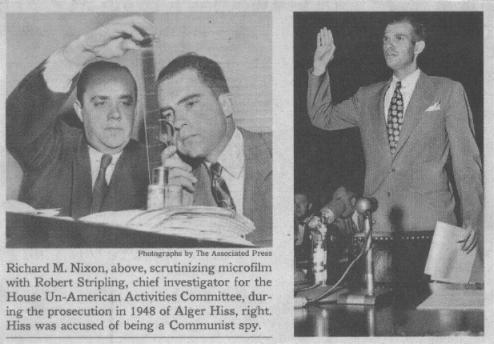
II. Donald Flanders 12
Q. What we would like is merely as deep an understanding of the relationship with the Hisses as we can get.
A. Well, we felt ourselves to be relatives, so to speak. We weren't, strictly speaking, because the relationship by marriage was one extra link, but we were all approximately the same age, and had a fairly similar background, I suppose, not entirely, but everyone of us was related to somebody in the group by marriage or blood. We felt ourselves to be essentially in the same family.
I might say that my wife was a birthright member of the Society of Friends. The Friends use among themselves the so-called "Friendly" speech which has degenerated by this time into using "Thee" as the nominative case in addressing a Friend. My wife and I, when we became engaged, adopted this as a form of tutoyer, and have kept it ever since. In that sense we use it among the family. My wife's sister Roberta, also uses this in the same way. We have extended it to the Hisses. That indicates the warmth, our feeling of the warmth of our relationship.
Q. You visited the Hisses on your way to Los Alamos? Did he know where you were going?
A. No. That is, perhaps I should give you a little indication of how I first came in contact with the job and my reactions to the security business.
At that time I was completely new to security. I had never had any experience with a secret job or anything of the sort. When I went to see Professor Bethe with regard to the possibility of taking this work, Professor Bethe was then at the so-called Radiation Laboratory at Cambridge, Massachusetts.
Q. Did you take the initiative in the employment or did the Commission approach you, do you recall?
A. The beginning of it was the receipt by Professor Courant of a letter from Bethe asking whether Courant could recommend anyone for this work. Courant asked me if I was interested, and I said I was. Then Bethe wrote asking me to come to see him in Cambridge. Bethe impressed on me how very highly secret the work would be. He said that it was expected that our mail would be addressed to us through either Chicago or Berkeley; that we were not to let anyone know even what part of the country we were going to. So I was duly impressed by this.
Something like two months or so elapsed before negotiations were resumed between me and Bethe. Then during that time I just didn't say anything to anybody about this. Then the offer came to me of this position; I accepted. Various letters had to pass between me and Los Alamos.
The first thing I knew I was getting in the mail letters from Los Alamos with that on the outside of the envelope, which my children picked up in the post office. It was obvious that the security wasn't being taken by any means as strongly as had been represented to me when I saw Bethe. My security somewhat broke down. By that time they were no longer expecting to have mail fowarded only to Chicago and Berkeley. They were going to have it sent directly. As I say, this mail came to me. I couldn't conceal it from my children. I had to tell them we were going somewhere. I couldn't conceal from them the state where it was, obviously. I got a rather dim view of who secret this was after all, unfortunately. When I got to Los Alamos, the question I asked was, "How secret is this place?"(I told him about these things.) I told Oppenheimer about it.
As it turned out, they never sent me the proper instructions for going to Los Alamos. I went directly to the guard gate and asked them to let me in,
II. Donald Flanders 13
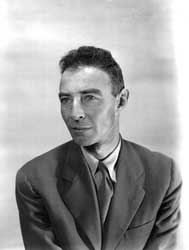
and they had to bring Oppenheimer to get me in. I arrived about nine in the evening. He took me over to his house and gave me a drink. I asked him, "How secret is this place?" I told him that as far as I was concerned, everything had deteriorated. He said that these were mistakes that never should have made, and he impressed on me that this was very secret.
But, in between the time that I first heard of it, or the time when the negotiations were resumed and the time I got to Los Alamos, I had gotten to the point of telling people I was going to the Southwest. I did not say I was going to New Mexico. I did not say I was going to Los Alamos. I said I was
J. Robert Oppenheimer
going to the southwest on a government job. That I told the Hisses as well as other people. I said nothing closer at any time. but, it was not as secret as they had asked me to keep it originally. As I say, it broke down because of this carelessness and my inexperience. I wouldn't have done this now, but I did it at that time.
Q. On the way to Los Alamos you visited the Hisses? You were employed by the government, and you had knowledge of what the project in Los Alamos involved?
A. Now, just one moment. I was informed what the project was. I have never been a physicist. I did not have knowledge of the full implications of it by any means. That was completely new to me. I didn't gather the significance until I reached Los Alamos and had been indoctrinatated for a couple of months.
Q. What was your idea of the significance of it at that time, Doctor? What information was given you?
A. Information was given to me that it concerned the application of nuclear physics to the development of a super explosive. That was all.
Now, if you recollect, the physicists themselves put a voluntary censorship on work in nuclear physics during the few years--I don't know how long-- but just prior to that, certainly in 1941, and I think from 1931 on, I had no close connections with physicists prior to going to Los Alamos. I remember having read one article in perhaps a Sunday supplement or something about nuclear physics. That was all I had ever heard of it, and as I say, I was so completely ignorant about the subject that I din' really--well, I was almost willing to believe that it might be hare-brained. It was out of my ken.
Q. You had no idea how the mathematical knowledge you had would fit into this at all, did you think about that?
A. Well, yes. I had been told they wanted to have computations performed, and particularly the solution of ordinary differential equations. From my early work as a graduate student, in astronomy, I had been familiar with numerical computations and particularly the solution of ordinary differential equations. I had no knowledge of what these particular equations would be, what significance they would have in the physics of it at all. In fact, I told Bethe that I was so little a physicist that it should be clearly understood that any problems that were brought to me must be mathematical, not physical. That is still true. I have no knowledge or competence in physics.
Q. Coming down now to the trip in 1943, you visited the Hisses. You had, according to your statement, a very high estimate of the man's intellectual capacity. He occupied a position of some significance in the State Department. You were headed for Los Alamos to participate in this significant work. But, I take it, you are testifying that you did not have any conversation with him on that occasion about nuclear physics?
II. Donald Flanders 14
A. I would guess that Alger Hiss knew as little about nuclear physics as I. I remember at one time discussing the parallel postulate in geometry with him. His mind is so little mathematical that I did not have very great success in making him understand the modern attitude toward non-Euclidean geometry.
This was not a long conversation. I didn't have an opportunity to really give him a good lecture on the subject. His forte was in the social sciences, definitely, not the mathematical and physical sciences.
Q. Did he discuss Principia Mathematica with you, do you recall?
A. He might have, although I don't remember that. That would be a subject in which I was somewhat interested, and the foundation of mathematics has always been a subject of interest to me. With intelligent people I often drag in, against their will, topics of that sort. So I may have done so. I have no specific recollection.
Q. Now, during that evening did he say at any time? "What are you doing here, Moll? What is up? Where are you going?
A. We had already, I assume, in Sara's letter told him we were going on a government project in the southwest. That was all. It was understood between us that it wasn't the thing to do. I didn't ask him about his State Department work, and he didn't ask me about my work either.
Q. Did he know specifically that you were going to Los Alamos?
A. Los Alamos? To the best of my knowledge and belief, no, although it may have been that due to this weakening of my own regard for security I may have mentioned Los Alamos. I don't guarantee that. I think my general policy was to mention only the southwest.
Q. Was his work for the State Department at that time confidential?
A. That I did not know?
Q. Why didn't you ask him about his job?
A. Well, I just assumed that in people in a place like the State Department, you wouldn't ask such questions; that is, I would assume it would be confidential. I assumed that he had a sufficiently responsible position.
I may say that at earlier times when I have talked with him--I remember on this visit to the Hisses in Washington that we have mentioned, with my wife, that the subject of international politics came up, and in a vague sort of way we--shall I say--I, not we--sort of tried to feel around to see if we could get any inside dope. We never got any inside dope. He was extremely discreet.
Q. Specifically, what type of inside dope?
A. Well, I don't know what I was fishing for, but, you know--we were talking about the Spanish Revolution. That was the subject, I am sure.
Q. Speaking of the use of the term nuclear fission, wasn't it taboo even to refer to it as such? I was in the army, and we couldn't mention it.
A. I would say that until I reached Los Alamos no one had said specifically that the term nuclear fission was taboo. I was told by Bethe that the whole subject of what they were doing was taboo, including the details. I am not even sure that I was sufficiently conversant with the terms fission to have remembered it particularly. It was not part of my working vocabulary at that time.
II. Donald Flanders 15
Q. You are positive you didn't mention it?
A. Well, I don't regard any question of memory as being positive. I am a mathematician. I do not regard it as being humanly possible to make a positive assertion about the past. I can say to the best of my knowledge and belief, it was highly improbable, a very high degree of improbability that I would have mentioned those things. I cannot conceive of my having done so, but if a dictaphone had been in there, I might have said it. I don't know. I can't believe I ever did. There was no occasion for me to do so.
Q. Give us some details of your acquaintance with Fuchs.
A. My first meeting with Fuchs was in Oppenheimer's office. I think every Tuesday afternoon after lunch the group leaders of the theoretical division met in Oppenheimer's office to discuss the theoretical problems of the division. At one of these a new man was present, and he was introduced as Klaus Fuchs, a physicist and people know about him. I did not know about him. He lived in one of the men's dormitories. I think one in which a number of young scientists whom I knew either in my work or socially lived, so that I got to know him more or less through them. Also, Mrs. Flanders and I made a general practice, I think, whenever any new man came into the theoretical division, of inviting him and his wife to dinner at least once, just to welcome them to the community socially. I am sure that Klaus Fuchs was at dinner at our house at least once, not frequently, and maybe only once. We saw him frequently at other people's houses. I was him, of course, in connection with my work every day, that is to say, I did not have to deal with him directly every day. I saw him, and said "Hello" and so on. I may have talked with him, and he was accepted as a member of the community. I saw him as I saw other people in the division.
Q. Have you formed any opinion as to why a man such as Fuchs would have done what he did?
A. Yes. One has to form some opinion. I must say I was rather taken aback by it. I would not have thought it likely from what I knew at Los Alamos. I would say the only objective symptoms so to speak that seemed to me to make it at all plausible, to cause me not to be too much surprised, was that he seemed an overly shy and retired person, not really well-adjusted socially. One felt that he was just too--I felt, shall I say, that he was just too withdrawn into himself for his own good. He wasn't sufficiently an outgoing personality. I don't think anyone would be able to say that they knew him well, intimately. Such a man could be concealing a lot of things, of course. That was my feeling.
Q. Would you describe him as an introverted person?
A. Very introverted. He had a physical tic which is often associated with such types. It was a sinking of the eye, an involuntary winking of the eye. No, it was a convulsive movement of the adam's apple. It may have been in the eye too. The was a sporadic and convulsive movement. I felt--one felt that he wasn't really at ease in society.
Q. That would mean that in your opinion this was a revolt against his environment that caused him to disclose--
II. Donald Flanders 16
Well, no. At that time I did not regard it as such, certainly.
Q. Looking back, hindsight.
A. Yes, it might easily be a symptom of inner conflicts that he just never revealed. As I say, he seemed to be--superficially he was friendly, agreeable, but as I say, he was so much to himself that one didn't feel, I would think, I don't believe that his friends there, the young men living in the dormitory with him, ever felt that they were close friends of his. I doubt whether he ever makes close friends.
Q. How do you tie that in with a disclosure contrary to security regulations? Why would this introversion---
A. Well, as I understand Fuch's history, I think I can understand more or less what happened to him. He was brought up in Nazi Germany. I believe his father was a Friend. I would suppose that he was a very idealistic young man who under the conditions of Nazi Germany came to believe that the only way out was through Communist and he convinced himself so thoroughly that he just sold himself down the river, that is all. He had warped his whole sense of values by this. That is the sort of explanation that I have made to myself on this.
Q. When did you originally become acquainted with Stanley Frankel?
A. Almost as soon as I got to Los Alamos. At that time the theoretical Physics division, of which he was a member, was quite small. Both he and his wife were working in it, his wife as a computor. I certainly met them in the first working day and continued to know them and knew them, I think fairly well, all during the time I was at Los Alamos, and counted them among my friends rather than acquaintances.
Q. Would you describe your relationship as fairly close or casual?
A. Say, fairly close. That is, they were much younger people than we were; closer to the age of my older daughter than they were to us. But, we like them, and they liked us, and we often dined with them and they with us. We were on a friendly footing.
Q. Did you observe in them anything that might warrant denial of security clearance, any expression of opinion or action, activity, or association?
A. No. I would say not. There was only one small thing that bothered me completely about them. They grew up in Los Angeles where everybody owns a car. They had two cars, one for each of them. During wartime, I thought they might have relinquished one of them and saved gas. They brought their tow cars to Los Alamos and kept them while they were there. I thought it was a little bit--they might have done a little bit more, but I didn't--
Q. Now, going back again to almost where we started, the summer meeting with Priscilla Hiss after the conviction, did you or did you not talk over with her the guilt or innocence of Alger Hiss?
A. I did not question--his innocence was tacitly assumed. I did not question his innocence.
II. Donald Flanders 17
Q. Assuming that testimony of Chambers was perjured, much of it, what motive would you assign him for perjuring himself in the Hiss case?
A. Well, the motive that I assigned, I suppose, is not entirely of my own concoction. It has arisen in part in talking with Alger and Priscilla about it. But my theory for what it is worth is that when Alger and Chambers first met, Chambers was down on his luck, was an intelligent man and a fluent talker, who superficially attracted Alger; that Alger befriended him, and then found that Chambers was sponging on him. Ultimately, that this created in Chambers' mind a feeling of guilt with respect to Alger; that Chambers is a sufficiently emotionally unbalanced person so that combining that feeling of guilt with a feeling of envy, because Alger was having a very successful career, and Chambers, who I assume was an equally intelligent man, was getting nowhere. Combined with his en of Alger, that caused him to magnify the whole thing out of all proportion, and to create essentially a, well, shall we say, psychopathic situation. He then deliberately plotted to destroy Alger. That is my theory.
Q. Did you consider the corroborative evidence?
A. Well, I cannot recall all of the details. I can remember one which seemed to me completely contradicted by my experience. At the second trial, a witness was brought who asserted she had been the Chambers' maid. If my recollection serves, she claimed she recognized Alger as being a person whom she had seen in the car outside the Chambers' home on one occasion ten years before. I just couldn't believe it. That is the sort of thing, it seems to me- I have had some experience of this. I spent the years 1937 and 1938 in Denmark. During that time, I went to the Mathematics Institute in Denmark. There was a young mathematics student whom I saw five days a week at lunchtime, and saw him in a least one course of lectures over a period of, say, thirty weeks during that year. There was a girl, a physics student, whom I saw at lunchtime quite often.
I came back to this country. I had no particular interest in these people. I saw them practically every day, as I say. This was in 1937-38.
In 1946, I believe it was, I received a request from a Danish professor of mathematics to meet at the boat a young man who was coming to teach for a year or two. This Danish professor, Jessen, asked me to meet him and help get his tickets, let him see New York on his way, and be nice to him. I didn't recognize either of them. I could have sworn I had never seen those people in my life.
When it came to meeting them at the boat, I with difficulty established who they were. We got together. I took them up to our farm. It was tow or three days before I suddenly remembered, was able to associate this girl, Mrs. Tornehave, with the physicist I had seen. It was a full week before I recognized the mathematician.
I just don't believe in the sort of recognition that you can get on the basis of seeing a person once, ten years ago. It is nonsense, in my estimation. I wouldn't give any credence to it.
Q. What did you think of the documents in the so-called group of "Pumpkin Papers?"
A. That seemed to me a pretty absurd business. You notice that Chambers didn't come out with anything until he was forced to. It was the fact that Alger was suing him for libel that made him bring all those things out. How he manufactured them, I don't know. But, I am sure he manufactured them. He brought them out when he had to have them. He couldn't get away without having something. I don't think for a minute that those things were genuine.
II. Donald Flanders 18
Q. You feel very strongly about the case and the result?
A. I surely do. I have know Alger well enough to--while I cannot say that anything is inconceivable of any human being, still, so far as it is humanly possible to assert trust and confidence in another individual, I believe in Alger Hiss.
Q. And that applies also to Priscilla Hiss?
A. Yes, I don't feel--well, Priscilla isn't the direct object of the calamity so to speak, but with respect to her, I see no reason to believe that she had any complicity in this.
Q. What is your opinion of her loyalty?
A. Absolutely unquestioned; absolutely unquestioned.
Q. I take it there is no difference of opinion between you and your wife in the solicitation of funds in defense of Hiss, is that right? Both you and your wife did attempt to solicit funds.
A. My wife did. Whether I did or not, this is one of the jobs that I left to her. It was not because I was afraid to or because I wasn't in sympathy with it. It was because she had the time and I didn't.
Q. You acquiesced in he doing so?
A. I certainly acquiesced. I supported her and encouraged her in doing so. I take full responsibility for doing that.
Q. Based on your knowledge of Hiss, what evidence would you need to establish in your mind his guilt, not of the charges he was convicted of, perjury, but the underlying theme of espionage and the like?
A. That is a very difficult question to answer because one doesn't know what it could be, you see. I can say this; Of course, you understand that to some extent I am emotionally involved here, and I beg your pardon for being quite so much. What I wanted to say was this: I can't say of any human being that I know him fully. No one can know anyone else completely. There are evidences, I think, in the past that people have been terribly mistaken in their judgments about people. I may be terribly mistaken in my judgment of Alger. I hope that if what seemed to me more convincing evidence were presented I would be clear-headed and unemotional enough to recognize it. What that evidence would be, I don't know. It is hard to put oneself in a position of trying to imagine how one could be convinced of something that seems to him so highly improbable as Alger's being a communist seems to me. I certainly, as I say, can conceive that I have been completely wrong, but I just cannot understand who a person could be such a consummate actor during the years I have know Alger as to harbor within his sould a willingness to sacrifice his country for a panacea. He is not that sort of guy. He doesn't think in terms of sweeping solutions to social problems. He is a much more mature man than that. It is just contrary to his way of thinking.
Q. Does he seek power? Is he a power-seeker?
A. I would say he was ambitious, but not unreasonably ambitious. I wouldn't
II. Donald Flanders 19
have thought of him as being a person who would trample too hard on other people in an effort to advance himself. He seems a very considerate person, and has always seemed so to me.
***
We acquired this farm in New Lebanon in 1929 when we lived in New York.
Q. You still have that farm?
A. Yes, my children won't let me see anyone about selling it. It's not much use to me 1,000 miles away.
Q. If Hiss is paroled, would you feel free to visit him as frequently and talk with him as intimately as you have in the past?
A. Let me make a somewhat more extended answer to that. I would ask you to consider that on the assumption of Alger's innocence he has suffered a great and frightful calamity, such as few people have to endure. That is, if you assume that he is innocent.
Now, my attitude is based on the assumption that he is innocent. I believe that he needs every friend that he can get. I would want to be able to befriend him not merely by, say, a note once and for all saying, "Alger, I love you, but I cannot see you." I would want to be able to visit with him as occasion offered, and to talk with him and to do what I reasonably could to help him. I feel that it is not enough to merely say, "Hard luck, old chap," when he needs positive befriending. I would want to maintain my friendly relations with him.
Q. Although as a mathematician you have testified that you will admit a possibility that he is guilty, not only of perjury, but the underlying theme?
A. Yes.
Q. Which would mean that you would feel under a duty to befriend him, communicate with him, even though you know there is this possibility?
A. I know there is this possibility.
Q. Were your contacts unguarded and frank?
A. Yes, that is to say, in so far as they dealt with matters about which one is ordinarily unguarded and frank. For example, let us say it would be any confidential business connected with the work of either of us, that would be guarded and was, but when I say "unguarded and frank" I mean when we are talking about things in general. We did not feel that we had to conceal our true opinions from each other in any way, that is, there was sufficient rapport so that we could speak freely. Shall we say that our basic philosophies were sufficiently in accord so that we could speak freely. I am speaking of my interpretation. Perhaps Alger didn't feel that way. It certainly seemed to me that he felt that way.
Q. Do you have any recollection at all of the visit by the Hisses, Christmas, 1936?
A. A very distinct recollection because Timmie, who was Priscilla's son by her first husband, came down with chicken pox while at our house and gave it to our three children, so I remember the visit quite well in that respect. The Hisses, or their lawyers, asked us whether we had a sufficiently detailed recollection of that so that we could testify to the exact time when Priscilla left our house. We did everything we could think of to try to establish that. We would have given
II. Donald Flanders 20
our eye teeth to be able to swear that she had left at such and such a time, and the alleged meeting between Hiss and Chambers was impossible. We talked the matter over, looked for any letters, memoranda. The most that we could say, our belief was that Alger and Priscilla took a train to New York on the Sunday evening of Christmas Week. I believe that New Year's day was Thursday. Christmas and New Year are on the same day of the week. Priscilla at least stayed overnight, leaving Timmie at our house. She returned on Monday to find that Timmie had broken out with chicken pox. I am not sure that we didn't recognize was most sick, and returned to Washington some day that week. We think it was highly improbable that she could have left by Wednesday, though we are not certain she did not. Timmie had rather a light case. She might have left Wednesday or Thursday. We did not feel that our evidence, where we couldn't say with reasonable certainty that she didn't leave until Thursday would be good testimony. If we were uncertain, we felt that would not be helpful. We very reluctantly had to say that we were not able to provide certain evidence that she had left our house on Thursday, which is the day we think she left.
Q. Your recollection would be consistent with her leaving on Thursday?
A. Not Tuesday. Possibly Wednesday, and it was just because there was that lingering doubt in our-minds that she might have left Wednesday. We know that she left sooner than we wanted her to, but we think it was Thursday. That would be New Year's Day. (Chambers had testified that she was at a party with him New Year's Eve.) It was that close. It was just impossible to be certain.
Q. In many families, Doctor, there are traditional ways of spending New Year's Eve, an accumulation of habits, I suppose. Do you have any such traditions connected with your family that would recall to you any change in that tradition of that New Year's Eve?
A. Unfortunately not. New Year's Eve has never been an important event in my life, or in my wife's since we met. I have never felt any enthusiasm about New Year's particularly. We often have gone to other people's parties, but we couldn't remember how we spent that.
****
Q. Your wife wrote a letter to a congressman in 1947 in which she characterized the loyalty program as a witch hunt. Do you want to add anything to your statement about that.
A. I have consulted Mrs. Flanders about that. It is her recollection that she wrote to the U.S. Senators from New York. The phrase she used was rather a current one at that time, as illustrated by the fact that in 1947 Mr. Sumner Pike wrote an article in the Atlantic Monthly entitled "Witch Hunting Then and Now." That referred specifically to this sort of thing. So that it seems to me that no inferences should be drawn from the use of this particular phrase. What the origin of it was, neither of us has any clear idea. I am sure that an examination of current newspapers, and so on, will establish the fact that it was a current phrase, not the property of any one organization.
This is rather beside the point, but I would like to add the following statement concerning this charge in particular. I, myself, feel quite indignant that a citizen may not write to his congressman without having what he says passed on to other government agencies. It seems to me this violates one of the fundamental rights of American citizens. I would make perhaps one exception. If there are letters actually threatening violence, then certainly........................pages 21 and 22 missing
Donald Flanders testimony continued