II Donald Flanders 23
I feel that one who writes about another person with the knowledge that it is going to be read by that person can never speak frankly as he can if he knows that the person involved will not see it. This applies not only to unfavorable but to favorable statements. Therefore, since I had a firm conviction of the strength of my own case, conviction of never
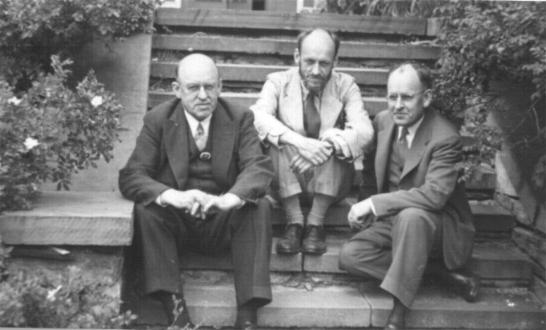
Donald, center, with brothers Ralph, left and Ernest, right, 1943
having done anything that I felt that I was ashamed of relating to the matters of this hearing, had no hesitation in asking that these letters be withheld both from me and my council, so that they might be as full, free, and frank statements as possible.
I did make a single reservation. It would be possible, particularly in reference to persons in category 1, that some employee of mine unknown to me might hold a grudge against me and so might submit some derogatory information that in my estimation must be false. I felt that it was only fair to me that I should have the same right with regards to this information that I have with regard to the FBI information, namely that I should know the nature of it without knowing the source. I did ask for that in connection with sending out the requests for affidavits.
Q. Were the affidavits in fact withheld from you?
A. They have in fact been withheld from me and my counsel.
***
When I first became interested in socialism, I believe that have said I felt that socialism had a distinguishable political philosophy and did not believe there was evidence of an important difference in political philosophy between the Democratic and Republican Parties For some time I continued to vote, at least on the national plane, for the Socialist Party because felt that its ultimate objectives were things with which I was in sympathy, and that one should vote as one felt; without too much compromise.
Largely, I think, because of my intimacy with professor Courant, and with other refugees from Nazi Germany, I changed my opinion on these matters particularly with reference to voting for small parties that had no chance. I would say that the almost universal opinion of such people was that one should work with a major party, and that one of the features of the Weimar Republic, of the French Republic, the absence of effective, large parties. In addition, that it was important that these parties should not differ too fundamentally. If the issues are too strongly joined on matters that seem to fundamental, then the effect of political operations is likely to be dangerous. If we had, for example, a large Communist Party opposed to a large non-communist party, even let us say not a large communist party but still a significant--I one do not not consider the Communist Party to be significant --if the nation were seriously divided on fundamental matters, this would very likely result in a non-peaceful solution of the problems, The conviction grew on me we are much better off in having two large parties whose overall philosophy is perhaps not too clear, but they are certainly democratic in the small d sense. They support our institutions by and large as I do. We are much better off having these two parties whose fundamental ideas are not too far apart, so that we can lose gracefully and feel, that its not the end of the world that our party was defeated .So, since around 1937, I have thought in terms of adherence to one or the other of the major parties. Usually my adherence has been to the Democratic party. I would not consider it inconceivable that it might be changed to the Republican Party since as have pointed out, they are not fundamentally in disagreement. There are important but not critical issues that divide them.
It is possible for us to get along without the excesses of really deep seated passion that would be likely to result if our political parties had essentially different philosophies.
II. Donald Flanders 24
So what I swung away from was the belief that I should adhere to a small and ineffective party, even though it came closer to what I felt were the desirable ultimate objectives.
Q. Any memory of the past is to the best of a man's knowledge and belief, isn't it?
A. Yes. I hate to say I never did because I don't know that I never did. No one can say that, it seems to me.
Is this the sort of legal fiction that when you say no to a question of that sort, it means to the best of your knowledge and recollection. If so, I will leave off the qualifying phrase. To me, no means absolute certainty. I can practically never be absolutely certain. It doesn't seem to me reasonable to expect that any person should be certain about his recollection. So what is your wish with regard to my response?
Q. I would say my question was directed to this: that you are not differentiating the two types of answers, one a certain answer and the other to the best of of your recollection and belief. When you say, "the best of my recollection and belief", don't you mean, no, as closely to absolute certainty as you as a human being can say it?
A. Yes, that is true.
Q. I wanted to be sure that there wasn't an inference that somehow the addition of the phrase made your answer a second-rate answer rather than a first-rate one.
A. There is no intention to make it a second-rate answer.
Q. There are some things that you are testifying to with absolute certainty. You testified before this board on Monday, for example, isn't that right? You would testify to that without any qualification, wouldn't you?
A. My memory might be wrong, even as to that.
Q. So if you testify that you had no communication with the Hisses while you were at Los Alamos, that might be mistaken?
A. That might be mistaken too. Anything that is in the past is ipso facto indefinite in my estimation. One cannot assert that his memory is exact on any event.
Q. But when you state something, you mean it as to be taken as your best, honest and closest to accurate answer you can give, is that right?
A. I do indeed. I intend throughout this hearing always to answer as accurately and as honestly as I can. It is just the nature of my training, logic, and so on. I don't like to use unqualified assertions. Unqualified assertions are often not true, particularly when one is dealing with one's memory. I have a rather poor memory, actually. It is my custom to say that as far as my remembering numbers is concerned, I know there is zero and one. Other numbers are unimportant because you can generate them from these. I have a poor memory for numbers in spite of the fact that I am a mathematician. The thing that amazes me about physicists is the number of particular figures they remember.
II. Donald Flanders 25
Q. When you answered that you had not written the Hisses, you meant that you were giving an answer as close to absolute certainty as you could, is that so?
A. Yes. Now, with a statement of that sort, on what does one depend? Surely I cannot be expected to remember every letter I have ever written. I depend much more on my habitual actions. I have said, and I believe it to be true, that I just do not correspond. Probably since I received your letter on September 15 I have written more personal letters than I have ever written in the whole preceding course of my life. So I am not in the habit of writing letters. It seems highly unlikely that I should have written to Alger, because Sara was there to write to Priscilla. Why should I bother? I never wrote a letter I could get out of writing, so to speak. But, this does not mean that I have been able to recall the whole of my history from 1943 to 1946 and that I could assert that I have accounted for every minute of my time, and I know that at none of those minutes did a I write a letter to Alger Hiss. You do not expect me to do that. But, I can only base such an answer on the fact that there is in my mind no specific recollection of having written a letter, and in addition, the fact that I am not in the habit of writing to my friends.
Between these two, I may say with confidence I never did, qualifying it in my own mind, to the best of my knowledge and belief.
Q. You have the same general attitude towards loyalty to the United States? If I said to you, according to your present testimony you could not testify absolutely that you had never performed a disloyal act in respect to the United States Government, you would answer, "I could not so testify?"
A. No. I must say once and for all, I do not believe it is humanly possible for anyone to testify with a degree of probability of one, to any event in his past. If you wish me to attach some empirical probabilities to my statements, I would be glad to do so.
For example, with respect to my not having committed disloyal acts, I would be perfectly willing to say that the probability that I had no done so was something like one minus ten to the minus fifth. This means that it is very, very close to absolute certainty. But it is not absolute certainty. Absolute certainty almost could be said not to exist at all. It does not exist in human affairs, and it is questionable as to whether it exists in physical affairs. By human affairs I meant things perceptible by human beings.
Q. Does it exist in mathematics?
A. In mathematics, as a pure science, it exists. In mathematics as applied probability, the question as to whether probability one is properly applied to any phenomenon is probably debatable.
Q. Self-existence is debatable under that attitude, isn't it?
A. Well, there one gets into very fundamental philosophical problems. And I have no guarantee that you and I would necessarily mean the same thing by self-existence. If we could define it to our mutual satisfaction, it might be that we could generally agree that probability one should be attached to it. But, I
II. Donald Flanders 26
think I could define it in a way that would strike you as reasonable, possibly, in which you would be willing to admit that even then, probability one , absolute certainty, couldn't be assigned to it.
Q. Now, at one point in your testimony you said something to the effect that your and Hisses basic philosophies were in accord. I want to establish what you meant.
A. Basic philosophies would be such things as the fundamental importance of truth, pursuit of the truth, good-will, sincerity, things of that sort. Those are things that seem to me quite inconsistent with the acts he was alleged to have performed.
Q. Would you differentiate as to your observations with reference to integrity and intellectual ability, or any other way you think is relevant, between Alger and Priscilla Hiss?
A. Well, Alger was to my notion the greater person of the two, greater depth, I would say superior intelligence. I don't think any greater good will. He made, I think, a more conscientious effort to be precise in his thinking and statements than Priscilla did. She is definitely above average in intelligence. I would regard Alger as being in a rather rare category so far as intelligence is concerned, in a high category.
I think Priscilla was rather less interested in abstract notions than Alger. She made less effort to be precise in her statements. She was capable of exaggeration.
In spite of these differences, I would still regard Priscilla as being a superior citizen, definitely above average in her intellectual and moral qualifications.
When I said I couldn't remember a single argument with them, I did not mean that we never argued. I mean that I couldn't remember the substance of single argument.
Q. When your wife solicited funds for Alger Hiss's legal defense, and you said that you felt that was the right thing to do, why did you think so?
A. It is the right, I believe, of every citizen to appeal a conviction. Such appeals are often expensive. In cases as this where I felt the convicted person was innocent, I felt it incumbent on me as his friend to assist him in any way that I reasonably could. I believe I did no solicitation myself actually. This was, again, one of the things I delegated to my wife. I may have solicited myself, I am not certain. I often talked in Alger's behalf, and endeavored to create a sympathetic understanding in his behalf.
Q. Earlier, you stated your opinion as to what you would like to accomplish by the hearing and your testimony. Would you state it now?
A. I would say that the objective that I try to keep before myself is that I should try to assist the board in making a proper determination in this case. Being human, I want to win if I can, but I try to subordinate that to what seems the more important question, enabling the board to arrive at a proper decision.
I wish to bring forth everything that is proper and relevant. I earnestly desire to suppress nothing. You have had one evidence of the fact that I am human. A question hadn't arisen, but I never volunteered the fact that came out. It is a reasonable inference that perhaps I wouldn't have volunteered it if it hadn't been brought to light. But, I would certainly have had it on my conscience if
II. Donald Flanders 27
I had not volunteered it, and I have it on my conscience that there was a hesitation in my mind not to have volunteered it.
****
We moved to Chappaqua in the fall of 1935 to live with an elder sister of my wife, who was dying of cancer. My wife is a trained nurse. We occupied that house during her illness until--her death in 1936--until 1943, when I left to go to Los Alamos. We still owned the house after the war and came back for one year. We then sold the house and moved to New York City. So we were there nine years in all.
Q. Were you pretty well acquainted in that community at the end of the period?
A. We occupied a house that had been the farm house of my wife's family, which had been held by her direct ancestors mostly on the distaff side since before the Revolution. My wife was born in the big house of this farm, big residence house in Chappaqua. She had lived there all her life until she went to college about 1915. She was very well acquainted with what one might call the native Chappaquaians.
I would say that it was perhaps in the middle 1920's that Chappaqua again began to grow as a commuting community, and what had been a settlement of perhaps a thousand people mushroomed enormously, so that she by no means--still speaking of my wife--by no means knew many of the new people. They just came too fast. Chappaqua is an awkward commuting distance from New York University. It is an hour's train ride to 125th St. Then there is a walk to the subway, a 25 minute ride to the Heights, and another walk to the University. I had at least an hour and a half commuting each way, during wartime, two hours. Therefore my contact with the people of Chappaqua was quite limited.
It was my custom to work at home on Saturdays and Sundays, and on days I was free. I have always put in a lot of overtime. We did make friends, but there were literally dozens of people my wife knew whom I couldn't recognize.
It is entirely possible a couple could have lived there for five years during that period and I not have met them. My orientation in social matters was toward New York City. Our quartet played in New York, or came out to see us. The members lived in New York City.
Q. Do you recall any occasion when you left any home for any significant period during which you left the keys of the house with the Hisses?
A. No. But there is this possibility: it is our custom when we leave the farm in the fall to leave a set of keys with a farmer who lives nearby, so that the man who comes to shut off the water can do that; also, some of our friends may come there for weekends. There isn't a very well defined procedure by which our friends are identified to this farmer. We are perhaps a little careless about this. But in every case they have been people who he has already met. To the best of my recollection, the Hisses never availed themselves of this.
Q. To what extent has your relationship to the Hisses been influenced by the fact that you are a Quaker, and of the Hisses is a Quaker, isn't that so?
A. I am not a Quaker. Mrs. Flanders was born a Quaker.
Q. To what extent does Quakerism enter into your relationship with the Hisses?
A. Not at all. Mrs. Hiss was not born a Quaker, nor did she become one. I think Alger was an Episcopalian. I am not conscious of precisely what church.
II. Donald Flanders 28
A. I should begin by saying that I consider---this is slightly facetious--that college professors are among the least well educated people in the country because they have to stick to their own subject and they don't do much reading outside. That applies to me. Practically continuously since I came to New York in 1929 I have read as my main newspaper the New York Herald Tribune. I have continued this here in Chicago. With magazines, my favorite is the New Yorker. It is the only one I read with a comparable degree of completeness.
Ever since we were married, my wife and I have continued the subscription that she had initiated before I met her to The Nation.
For a period of perhaps two years we read the English New Statesman and Nation, a six-month subscription of which was given to us by our friends the Bevingtons. We continued it, but stopped because we simply weren't getting read what we already had in the house.
Those are the only magazines that we have read consistently. I should perhaps add that we were given, last Christmas, a subscription to The Progressive, published, I think, in Wisconsin. John Alford, the present husband of Roberta, gave us the subscription. It is the old La Follette paper.
So much for periodicals. The next easiest thing to describe is that it has been our custom ever since we were married for me to read aloud to my wife after we went to bed before going to sleep. Such reading in general has consisted of literature. We have read, for example, all of the plays of Shakespeare in this way. We have read many of the 17th Century novels. We have, in general, not read contemporary novels in this way. Practically everything that we have read has been among the classics of English literature, things that perhaps we read before and felt we wanted to become more familiar with or extend our knowledge and appreciation of the classics of English literature.
Currently we are reading Boswell's Life of Johnson. This resulted from the fact that when Boswell's London Journal came out, we read that, and were much struck with the vividness of Boswell's personality as revealed in that, and wished to find out more about Mr. Johnson. Currently, we are reading that but we have interrupted it to read another installment of the Boswell Journal, Boswell in Holland. That indicates the general nature of that sort of reading.
Beyond that, most of the reading that is done in our household, you can see what a busy woman my wife is, is done by my wife. I read some novels, some have read very little poetry. I don't suppose that I read more than one contemporary novel a year.
Ordinarily I do not read detective stories to any great extent, although when I feel in a particular mood, I may indulge my self. I may say I have read more detective stories since September 15th than I have read in a long time. I can't think now of any significant additions to make to that list.
****
Throughout my adult life I would regard my political views as having been left of center. How far left of center has shifted. It has definitely shifted toward the center rather than away.
I might say parenthetically that in my discussions with my eldest brother, he feels that he is a conservative in the best sense of the word. He says, for example, that in 19th Century English political history it was the liberals who made the reforms and the conservatives who made them work. He believes that his function is to make things work, not to agitate for reforms. I, on the other hand, feel that my interest is perhaps more in agitating for reforms, not that I do much agitating directly, but, shall we say, my basic point of view, my direction would be of trying to make the changes, his, of trying to make them effective.
II. Donald Flanders 29
Q. What do you mean when you use the expression "a liberal"?
A. I think the best answer would be the views that I hold, and I am quite willing to tell you about them. I regard myself as an exemplification of a liberal. These words are very difficult to define.
A liberal is someone who doesn't want to throw the baby out with the bath, and at the same time thinks that not everything as it is is perfect, and there are changes that shouldn't be left too long to the processes of history. One ought to do a little pushing help produce improvements in the social organization. The baby needs a bath, but I am willing to do a little of the scrubbing as long as it doesn't involve too much work for me to do.
Q. Would it be fair to describe you as "ardently interested in the political scene?"
A. Well, I suppose I would like to believe that I am ardently interested, but the fact of the matter is that the political scene is not too large a part of my life. I feel it should be more. It should be more, a larger part of any citizen's life than I have permitted it to be in my own life. Ardent is perhaps too strong. Certainly---
Q. "Ardently interested in the political scene." It does not say ardently active.
A. Ardently interested, let us say. I will accept that.
Q. Ardently means burning?
A. Well, I burn sometimes.
****
Peggy Craft occasionally joined our quartet. Usually she came to play with my wife, playing cello sonatas. I would come out from my work and play one trio. If we were desperate for a cellist we might call her, but I don't believe she played with the quartet more than twice the whole time.
Q. Did you ever discuss the Hiss case with her?
A. Very likely, though I have no specific recollection of it.
Q. We have a report here to the effect that you reviewed the evidence in the Hiss case "dispassionately and carefully." Do you think that is a fair characterization of your knowledge of the evidence of the Hiss case?
A. I frankly don't think that it is. I don't see how I could be dispassionate in this matter, try as I will. I can't make any claim that I have eliminated the fact that I have a real and long friendship for the Hisses. That is bound to influence my judgement.
As we were going to lunch, I asked Mr. Despress how it was possible to get hold of a transcript of the Hiss case. It seemed to me that perhaps I really should have gone over the whole transcript. I do not feel that reading other people's interpretations of the case is particularly relevant. I feel that perhaps I should try as dispassionately as possible to go through the actual evidence presented in toto and then see what my decision is. That, I have never done.
******
Donald Flanders testimony continued