I had decided that I wanted to get more academic training so had applied for a course in mechanical engineering in the Rochester Technical School in Rochester, New York. This offered a co-operative course which would allow me to go to school for two weeks, then the following two weeks I could work as a machinist, earning money, hopefully enough to pay my school and living expenses.
However, before I went there the Norton people arranged for me four weeks of military training in Plattsburg, New York. This was under the planning and guidance of Maj. Gen. Leonard Wood, who felt the country needed men with some military training. In view of the First World War, which came in 1917 (and was already raging in Europe after 1914), his viewpoint was verified in 1916. I spent the month of August that year learning the basics. I was one of several thousand men from all over the East. To my surprise my brother Ralph also volunteered so we entered together. We were assigned to different companies so did not see much of each other. However, we were both glad of the experience and had much in common to talk about later. It was a training that demanded much of us, emotionally and physically. I won't go into detail except to recount that after three weeks of intense training we left Plattsburg for nearly a week of moving from place to place, carrying our clothes, blankets and pup tents. It was another interesting experience and we saw some lovely New York state scenery as a dividend.
My mind, of course, was on my next plans of entering school in early September, getting to work in my trade, making money to support myself.
Rochester was the home of the Ed Bosworth family. He was an old friend of my father's during Grantham days. My mother, Mary Lizzie Gilfillan, of Barnet, Vermont, had a close friend. Emily Norris, from the same area, who had gone to high school with her in St. Johnsbury. I have a picture of my father, Ed Bosworth, and Henry Flanders(#168-16A) taken long after they married. I don't know that I was ever told, but I am sure that my mother brought about the contacts of Bosworth/Norris resulting in marriage. They moved to Rochester and raised a family of three, two boys and a girl: Arthur, Ray and Clare. The girl I knew because she had visited us in Worcester after her mother's death. Now that you have a little background I will add that Ray Bosworth took me into his home as a paying guest, so I became well acquainted with the family. I attended and joined their family church, Westminster Presbyterian.
My first shop experience was with Gleason works, an important builder of bevel gear-cutting machinery, well known the world over. I did not enjoy my stay with them. First, I was not interested in the work; and second, I was not paid enough for my ability. So I was transferred to Taylor Instrument Company, well--known manufacturers, starting with thermometers. I enjoyed the work and pay and found I could produce more in a day than the old-timers. The foreman was very appreciative of my work.
Fall gave way to winter and I learned that the Bosworth daughter Clare loved to skate. I did too, so weekends and the free time I had, we spent skating together in Seneca Park. In the meantime I joined the church and sang in the choir.
I planned to continue on my course at the school, but international affairs turned for the worse, and the U. S. declared war on Germany. The whole plan was changed. Every young man had to register for the draft. My family wanted me to return to Vermont to register. My parents had left Worcester and moved to Springfield to be near my brother in their old age. So I left school and returned home and settled with them in their home at 31 Orchard Street, right next to the Hartness home.
I had never worked at my trade in Springfield, so to keep developing my skill and knowledge I went to work for Jones & Lamson. My brother Ralph felt that there was a great need for men of my training and ability.
After a short time an opportunity came up to work for a company in New Brunswick, N. J., who were building aircraft engines known as the Hispano-Suisa. I went down, was hired, and started work on final inspection of the engine crankshaft. I had hoped to get a job in manufacture, but I went where I was needed most. After a while I heard that they needed men to follow outside contracts all over the country. I applied, was accepted and was sent to Buffalo, N. Y., to work with the Pierce Arrow Co. Soon after, new contracts were given to firms in Rochester and Syracuse. It seemed wise to return to Rochester, centrally located between Buffalo and Syracuse. I was covering a half dozen or more different companies who were producing a wide variety of parts for the Hispano-Suisa engine. Ed and Clare Bosworth wanted me to take a room with them, which I did. I enjoyed being there and of course during the winter we indulged in our love of skating. In summer we had picnics down on the shore of Lake Ontario. It was a busy time, because of demands made on our suppliers. This was the year of the official end of the War, resulting in an armistice. For some reason a false armistice was celebrated in Rochester and over much of the country, one week ahead of the true armistice. It was a tremendous outpouring of relief from the strains we had been under.
I continued to work with suppliers, although the pressure put on all was relieved. My brother suggested that I head the J&L service people and work out of Rochester, from New York state on the west, West Virginia on the south, and Syracuse on the east. North I would cover Canada from north of Detroit to Montreal. I went back to New Brunswick, resigned from what had become Wright Aeronautical Corp., and became a service man for Jones & Lamson Machine Company, of Springfield, Vermont, working out of Rochester. That kept me away from home most of the week, home weekends. Sometimes I was called into the Detroit area when they needed help. I enjoyed the work and travel, at that time mostly via Pullman on the railroad.
Another big event transpired in 1918. Clare and I had become so close in interest and friendships that we finally decided life together would make it perfect for us both, so we became engaged and were married on June 20, 1918 at her home at 407 Magnolia Street. Our families joined us, making it a wonderful occasion. I was very busy, so delayed a lengthy wedding trip until later. We did go to Niagara Falls, as many newly married couples did; then back to my routine, being away most of the week.
Another event was the birth of our son Ralph on February 23 in Rochester General Hospital. Business was tapering off, so I was offered a position with the company in Springfield. My parents were living there. I didn't want to be a city dweller, so in October 1920 we arrived in Springfield. I have made my home there ever since.
My mother and father were getting quite old and were finding it difficult to get around. They were living in a house owned by Mr. Hartness, next door. By mutual consent we moved in with them, taking over many of the cares and duties. They did not want to spend another winter in Springfield, so went to be with my sister Emily for the winter. There was a tenant upstairs, Mrs. Adams, who got her heat from our coal-burning boiler, which was given to me to feed and care for.
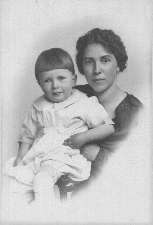
Ralph N. Flanders and Clare Flanders
I went to work in the shop, extending my knowledge in fields I had not
experienced By choice and chance I became enveloped in new projects, of various
kinds. The most important came to me from my brother. He had designed a
completely new machine for the area of manufacture not at that time available.
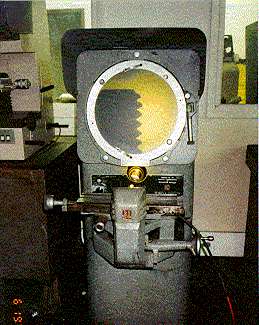
Hartness had designed a machine for checking the accuracy of some work
optically. If a piece didn't look right, in this case the thread on a bolt you
could quickly tell what correction was needed by studying the projected
magnified shadow shown against a chart. One common tool was found to be very
poorly made. This was called a tap and was used for putting screw threads in
nuts used with bolts. Their thread quality was so inferior, as proved by the
optical comparator, that my brother designed a machine for correcting thread
form on hardened steel taps, by grinding. The company had no money for building
it, so Ralph asked me if I would be willing to work without salary, finding two
other helpers who would work under the same arrangement. I was to keep track
of the hours
Jones and Lamson Optical Comparator
spent, and after business picked up we would be reimbursed. In the meantime we would build and get experience in a new field of operation. The two men I found and who stayed with me to the end were Ellsworth Johnson and Ed Black.
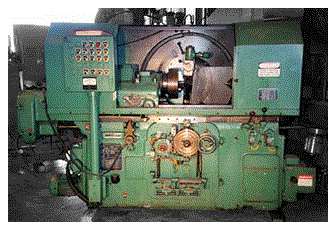
The new machine was called a tap grinder, designed for correction of form on hardened steel. It was designed to maintain size automatically within close tolerance, and automatically correct form on the grinding wheel used making the correction needed on the work. The wheel truing device was placed behind the grinding wheel always ready when needed. It carried two three commercial diamonds that would move across the face of the wheel in carefully designed movement, bringing grinding wheel form to correct shape. In most cases a sixty-degree included angle. The grinding wheel is designed to break down in use, so correction is always needed. My brother's clever design did not change relationship of diamond to wheel and maintained wheel- to-work relationship, so the size of the piece being ground was held to close finish size, automatically, even though the relative positions of grinding wheel and diamonds were constantly changing. It came out just as planned and we were able to demonstrate a completely new method of finishing master tools used in manufacture of essential parts. These machines came into great demand and were used wherever quality was essential.
German manufacturers of taps had a much more difficult problem
in thread form to meet their standards than we did. We only had to form a 60
degree form on the grinding wheel. The Germans had standardized on the British
standard (known as the Whitworth form) which called for a controlled radius on
the root and crest of a 47 and 1/2 included angle. They had heard of our tap
grinder and wanted to adapt their form to our truing devices. They appealed to
my brother, who had designed a completely new method of wheel forming designed
around a controlled path for carefully formed diamonds
Jones and Lamson
Tap Grinder
which produced the required radii for the many
standard pitches needed. A far more difficult problem than for U. S. standards.
The new truing device fitted into the machine and produced finished tap threads
that met the standard requirements. The man who wanted our grinder was named
Schaurte. He owned the largest nut and bolt manufacturing company in Europe.
His plant was located net the Rhein River in Neuss, not far from Dusseldorf.
Mr. Schaurte came to Springfield to visit us and check up on our methods and equipment. He was sold, but wanted someone in Germany to build the grinders for him.