He did find a company Richard Weber Co. in Berlin that agreed to build the machines for his use and to sell in Europe. I was asked to work in both plants for an extended period of time and to take my family with me. Clare was agreeable so we prepared to go when the time was right.
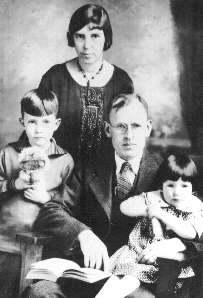
I got a family passport and tickets on the Cunard line to take us to England. We wanted to spend a few days in London so sailed to London direct, instead of by way of Southampton. We left New York a few days before Christmas. The ship was filled with passengers heading for England to spend the holidays. We had a bedroom that accommodated all four of us, It was a lovely trans- Atlantic trip, in view of the Christmas spirit. Evenings the passengers got together and sang carols. It finally ended at London docks. We took a taxi which got us to the hotel. They assigned a lovely large bedroom for us. We were surprised to find it was heated by a fireplace using coal for fuel. A young lady came into our bedroom, before we got up, to build the fireplace fire.
Ernest and Family, passport photo for Germany
Christmas was a very quiet day, which we were not used to. The next day, known as "Boxing Day," was very different. It seems that everyone spends Christmas quietly at home, but on the next day all bars are down and the holiday spirit predominates.
With small children, one can't do usual sightseeing. We all enjoyed the London busses, which we would take by chance, and travel to the end of its run, returning to where we had started. By this simple inexpensive way saw a great deal of London.
When our time came to go to Germany, we took the train to the British Channel, took ferry to Belgium, and from there train to Dusseldorf. An official came to me beforo crossing into Germany, making demads of me I did not understand. He wanted the keys to our luggage so to open it for inspection, Though the word for key is "die Schlussel, I learned it the hard way. We finally arrived at our hotel in Dusseldorf, where we stayed until established in Neuss, which was where we were to stay for a month. The place suggested was the Hotel Saridweg, adjacent to a large Catholic church. We got our meals there and spent much time in our rooms, I went to the plant to prepare the machine and operator for operation of the grinder. I began to pick up fragments of conversation. That was necessary if an operator was to be properly trained in the use of a machine, unique in operation and accuracy. I worked also with an engineer by the name of Reif, son of the chief engineer of the Bauer & Schaurte plant. It was interesting for me and I enjoyed working with mechanics. Through my months of contact both in Neuss and in Berlin I came to respect their ability and devotion to high standards in their work.
We arrived in Germany a short time after the collapse of the German money. People had lost a great deal besides money - savings, homes and personal property. The fact that Ralph and Eunice wore rubbers in wet weather attracted a lot of attention. German clothes were old and worn and ours were better. German people were having to start up from nothing. We felt very conspicuous. During the month we spent in Neuss, I was very busy in the plant with my associates, However, a young engineer who had worked in the United States invited us one Sunday to go with him for an automobile trip to Cologne and Bonn. We were impressed with the cathedral and the narrow streets of Cologne. A service was in progress in the unheated sanctuary of the cathedral but people came dressed for it. A choir of male voices was, for us, out of this world as musical accompaniment in the enormous nave. We did not spend much time there, but after getting around the city in mostly narrow streets, we went wouth up the Rhein to Bonn, now the capital of the West Germany Republic.
We ate lunch there and visited the birthplace of Beethoven before returning to Neuss. A wonderful day for us all.
We left Neuss and took the railroad to Berlin, the national capital of the German Reich. We were met there and taken to an apartment we were to use for the remainder of our stay. It was a roomy four rooms plus a kitchen. The owner was born and educated in Bloomington, Illinois. Her English was a great help to Clare. The family name was Kaphun. The grandfather of the family, now deceased, had owned forty tobacco shops in Berlin. He had lost all but two in the inflation. They lived in the apartment under us and had a son and daughter still in school. We enjoyed home life available to us during our stay.
Clare did not enjoy the German language. I had enough to get along with, and with our neighbor to talk with, life became more interesting for Clare. We found a church that pleased her, the American church in Berlin, which we attended every Sunday. There were English speaking people, visitors, students, workers. They made us feel at home and added much to our German experience. There was a forested park with a small lake across the street from our home. This was the place where children came to play from all over the neighborhood. There was no toilet available for them, so it was a common sight to see girls and boys using the adjacent gutters in case of emergency.
Because of the language problem, our Ralph and Eunice were generally accompanied by one or both parents when they went over for a walk. While we were in the city we visited lakes and pleasure spots, perhaps where we could get a table and by buying coffee eat a picnic lunch. There was a good zoological garden, open daily, and lovely walks in the woods.
I was working in the Richard Weber Co., some little distance from home. but easily reached by city transportation. I got along well with my associates and with the workers. Many men could not afford leather shoes, so provided themselves with wooden shoes. At any break in the work, such as lunch, the men coming down the stairs in those wooden shoes presented a terrific racket. The Weber plant was to build grinders as well as use them making ground thread taps. It became routine.

In late summer I arranged a vacation. Clare, Ralph and I decided to go to Switzerland for a few days. Eunice would stay in Berlin with our landlady. We went by bus through to Lake Constance. Then to Interlaken, Montreux, and Geneva. While in Interlaken I took a special trip up to the Jungfrau Yok. It was a beautiful trip to the area joining the Jungfrau and the Monk. Both very high. Snow lay deep on the ground in the Yok. I saw my first glacier.
My brother and family had come over that summer. We met them in Montreux. It was wonderful to meet family after months of separation. A joyous occasion. They were headed elsewhere, so we left them, heading for Geneva and then back to Berlin.
Clare, Ernest, Ralph and Helen with children.
There was a German living in Springfield, working at J&L. His name
was Reich. He helped me a little in learning some of the rudiments of the
language. When I left, he told me he had a brother living near Berlin andhoped I
could see him. I did call on him with the help of the American friend who was
fluent.
He had been forced out of his home in Germany and was living in an old army barracks near Berlin. He was living with his wife and daughter. He had been a fanner on the German border. He asked about his brother and showed me a five thousand Mark bond of the old currency, which now had no value. That was all he had to show for his life work, and it was valueless. I heard nothing more of him, and the U. S. brother died not long after our return.
This marked the end of our German experience. We got our things together which included a large wooden chest needed to take home extra items of clothing, gifts and other items we had accumulated. This chest is in the cellar. I keep tools in it and other things seldom used. Getting this chest to our home was interesting. It was large enough to hold both Ralph and Eunice at the same time. I was told by the man who made it that we could take it home on the trolley car. A single fare on it, together with our own, was the total expense. A simple inexpensive way to transport anything you can handle. For instance, a baby carriage with or without a baby in it.
Ralph and Eunice had not entered school in Germany. Eunice as too young, and Ralph had been given instruction from books given his mother by Ralph's first grade teacher. Our return in September made it possible for him to enter his new school. I might mention on thing about Eunice's learning that impressed her mother and me, She was so young that we had not taken her to Switzerland with us. She stayed with the Kaphun family during our absence. On our return, we noted she seemed to understand the German spoken to her and was speaking German in a simple way. It amazed us.
We sailed home on the Cunard ship Ascania out of Bremen, jammed into one third-class cabin in the bowels of the ship. Ralph and I made one purchase on the way to the dock. I wanted to take home a souvenir of Germany. We went into a shop and purchased a good pair of binoculars of excellent make (Zeiss). Ralph's wife Anne has them now and is enjoying them.
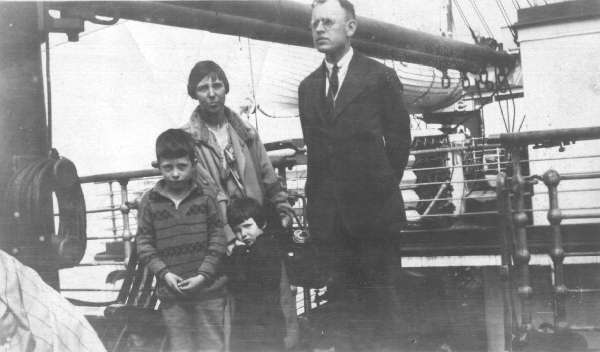
Looking a little green on the return trip.
I had a rough trip home. We ran into a severe storm when we got out into the Atlantic. I did not get out of bed or eat anything for three days. Eventually we passed out of the storm, and I enjoyed the final days of the crossing. Clare and both the children proved to be better sailors. They were up and eating while I was in bed.
We finally arrived in New York, took the first train north that would take us to Charlestown, and so, home! We were SO happy to be home again. Clare, particularly, was in demand as one to give the story of our months in Germany. I returned to work in the Thread Grinder Division of J&L. I was assigned to Research and Development. I never enjoyed routine. I felt much happier if I was faced with problems requiring an answer. This was my place in life in J&L for the rest of my active years.
We came back to the house we had purchased in 1924, a year after we had moved into it. It came from Hardwick, Vermont. We bought it from the Fellows Gear Shaper Co. A granite quarry had gone out of business and there was no longer need for workers' houses there, so a builder, LaFrance, took them down and put them up in Springfield. The Gear Shaper bought them from him and put them up on Hillcrest Road. I bought one for $3400 and have lived in it ever since. Some changes have been made but from the cellar up, most of the framework and sides came from Hardwick.